A few weeks ago I wrote about whether now is a bad time to buy a home in Fargo-Moorhead. Investors keep asking me the same question on industrial, office, and retail.
I'm Tyler Bretz, managing broker at Raboin Realty in West Fargo. I hold a commercial certification. The national story is not automatically our story. Whether it's a good time depends on the asset, the income, and whether the debt service works.
Debt is more expensive. That changes the math.
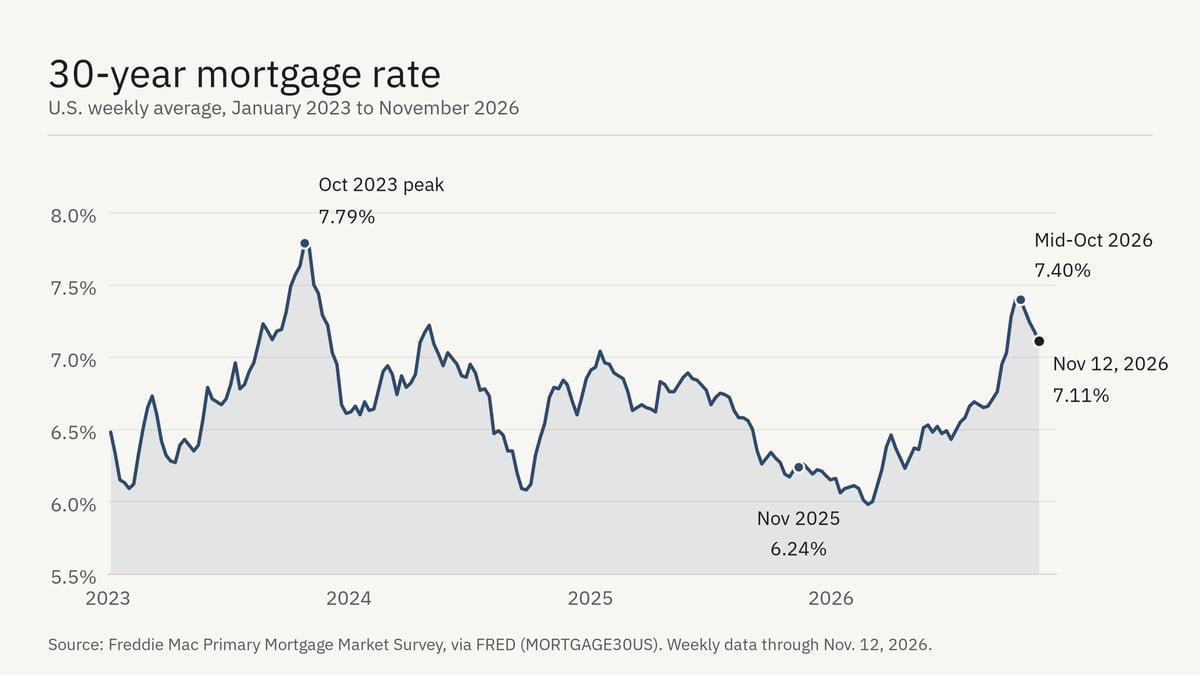
Commercial pricing starts with the 10-year Treasury, the benchmark most commercial loans are priced off. As of November 16, it closed at 5.12 percent, according to the Federal Reserve's daily yield series on FRED. A year earlier it was 4.13 percent. It touched 5.31 percent on October 5, above the 4.98 percent peak in October 2023. The bank prime rate, also from the Fed, is 7.00 percent.
If you buy at a 6 or 7 percent cap rate and your loan rate is close to that, the deal only works with conservative leverage or a very clean income stream. The number that matters is whether net operating income covers the debt with a comfortable debt service coverage ratio. I ask a simpler question: what is the NOI today, and does the coverage still work if today's rate is the rate you keep?
Industrial
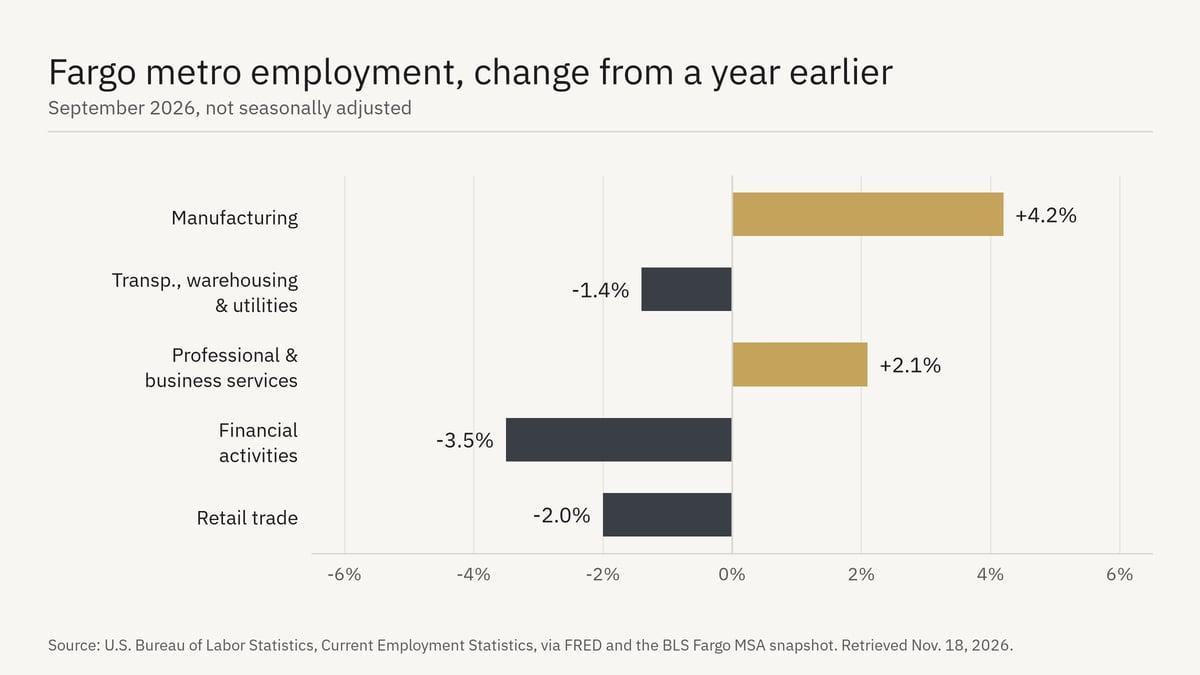
In September, the Fargo metro had about 12,500 manufacturing jobs, up 4.2 percent from a year earlier, according to the Bureau of Labor Statistics. Transportation, warehousing, and utilities employed about 7,000 people, down slightly from 7,100. Wholesale trade was about 8,400, down from 8,800.
City permit reports do not split new commercial work into warehouse, office, and retail, but they show where buildings are going up. Through September, West Fargo had issued 17 permits for new commercial buildings valued at $55.3 million, up from $7.6 million a year earlier. Fargo, through October, still had $194.5 million in new commercial permits, close to last year's $201.1 million. Moorhead was quieter, at $4.1 million, down from $22.7 million.
North of town, Applied Digital's Polaris Forge 2 campus in Harwood is nearing completion: two 907,000-square-foot buildings, with about 1,800 workers on site this summer. Part of the project is expected online by the end of 2026 and the rest in early 2027, with 200 to 250 employees when it opens. That supports some industrial space during construction, but that demand is not permanent.
I look for a building that fits the work and a tenant whose lease can carry the debt at today's rate. If the coverage only works while temporary users are in place, the deal does not work yet.
Office
Professional and business services employment was up 2.1 percent in September, to about 14,400 jobs. Financial activities, which often occupy office space, were down 3.5 percent, to about 10,900.
In July, the Fargo City Commission approved a five-year tax exemption for a roughly $5.4 million rehabilitation of the Dakota Center at 51 Broadway, a downtown office building that had been described as 46 percent vacant at the time of its sale. On 45th Street, the West 45th Business Center is being redeveloped as mixed-use. The commercial building is under construction, and in October the city approved a tax exemption for 229 apartments next to it, not for that commercial space.
We currently have a 15,020-square-foot office at 3523 45th Street South in Brandt Crossing, listed at $3,650,000, fully leased to the original tenant on a new five-year lease. The public listing does not publish a cap rate. As a hypothetical: if a buyer underwrote that price to a 7 percent cap, the implied NOI would be about $255,500 a year. From there you subtract debt service and ask whether the coverage works at today's rates.
I would not buy office just because the cap rate looks high. A fully leased building with coverage that works at today's debt is a different deal than a large, older floor plate that still has to be filled. If the income depends on a refinance or on leasing the rest of the building, it does not work yet.
Retail
Households here are still spending. Cass County taxable sales were $890.4 million in the second quarter, up about 5 percent from a year earlier, and $1.58 billion year to date, up 4.7 percent, according to the North Dakota tax commissioner. The latest official Clay County figure is older: taxable sales were $505.7 million in 2024, up 1.9 percent from 2023, according to the Minnesota Department of Revenue.
Retail trade jobs were about 15,000 in September, down about 2 percent from 15,300 a year earlier. The customer base is still growing. As of July 1, 2025, the Census estimated 136,275 people in Fargo, up 8.2 percent since 2020; 41,175 in West Fargo, up 6.6 percent; and 46,533 in Moorhead, up 4.6 percent.
New projects are still showing up in West Fargo. In October, Kwik Trip applied to redevelop the former Alerus Financial property on 13th Avenue East as a convenience store and gas station. Near Costco, the city confirmed $11.5 million in permits for an extended-stay hotel now under construction on Bluestem Drive.
Retail is about the corner and the tenants, not the metro average. I want a lease and a debt-coverage ratio that still work if sales flatten, not a hope that traffic keeps rising.
Multifamily, briefly
Fargo permitted $84.0 million of new multiple dwellings through October, up from $7.6 million a year earlier. Census data in the Greater Fargo Moorhead EDC's October indicators show metro multifamily units authorized through September up 38 percent. Supply is coming, so I would underwrite to today's NOI.
So is it a bad time?
It depends on the asset. Industrial can still be a good conversation if the building fits the user and the income already covers the debt. Office only works if the lease and the coverage are already there, not if you are buying a cap rate and a vacancy problem. Retail works when the location and the tenants are right, and when the payment works if sales stop growing.
It is a bad time to stretch on any of the three, or on a newer apartment, because the deal only works if rates fall. Higher debt costs have slowed some buyers, which is often when investors can talk realistically about price.
If you want to walk through a property or a debt-coverage scenario, call or text me at (701) 541-7192, or reach out to Raboin Realty.